Finding Your First Internship as a Waterloo Freshman
January 21, 2026
Context on Waterloo
Waterloo's co-op schedule varies by program. Co-op commonly begins in second year, while some programs start in first year. Students may complete between four and six work terms.
Check your program's sequence, then prepare well before your first scheduled work term.
The first search can feel strange because employers ask for experience during the process meant to help you gain it. I learned that the way through is to create evidence early and make sure people see it.
This guide uses a four-part approach:
- Build a story people can remember.
- Reach humans directly.
- Create proof before you have a title.
- Treat applications as experiments.
Build a Story People Can Remember
A first-year student rarely has a long professional history. Your advantage comes from being specific about the work you have already chosen to do.
Ask yourself four questions:
- Which problems keep pulling my attention?
- What have I built without being assigned?
- Where have I helped a group move forward?
- Why do I care about this kind of work?
The answers can come from projects or community work, as well as a club or hobby. The source matters less than the evidence it gives you.
If you contribute to open source, mention a specific pull request and explain why it mattered. If a hobby taught you a useful skill, connect that skill to the role so an interviewer has something concrete to ask about.
Your story should be easy for another person to repeat after the conversation ends.
Reach Humans Directly
Freshman resumes often disappear inside an applicant tracking system before a recruiter opens them. Direct outreach gives your application another path into the company.
Look for someone connected to the role through email or LinkedIn. A founder can be approachable at a small company, while a recruiter may be the better contact at a larger organization.
A useful message has four parts:
- A quick introduction.
- A reason you chose this company.
- One piece of relevant proof.
- A simple question or request.
Keep the message short enough to read on a phone. Skip the autobiography and make the next step easy, since even a brief reply can teach you how the company hires.
Rejection and silence are part of the process. Your goal is to create more chances for a real conversation.
Create Proof Before You Have a Title
Your resume is the foundation of the application, with visual polish helping once the substance is strong. A first-year resume usually grows from work completed outside a formal job.
Build one focused project that meets four standards:
- It solves a clear problem.
- A stranger can use it.
- The documentation explains your decisions.
- You can discuss what went wrong while building it.
A small finished project carries more weight than a large idea sitting half complete. Course assignments can become stronger evidence when you extend them beyond the rubric and show ownership.
Write resume bullets around your decisions and their effects. Real numbers help a recruiter see what changed because you were involved.
Treat Applications as Experiments
A strong resume improves each attempt. Consistent volume creates enough attempts for that quality to matter.
Use a simple loop:
- Choose roles that fit your current evidence.
- Tailor the resume to the role.
- Record the response.
- Revise based on the pattern you see.
Your tracking sheet only needs the company and role, followed by the date and outcome. After enough applications, patterns emerge. You may discover that one project earns interviews while another bullet gets ignored. Update the resume with that evidence.
Use Waterloo's Community
WaterlooWorks gives you a concentrated source of co-op postings. Student clubs can introduce you to peers who recently completed the same search. Upper-year students can review a resume from direct experience. Alumni can explain what their teams value.
Ask focused questions when someone offers help. Sharing the job description and your planned resume gives people the context required for useful feedback.
Conclusion
Your first internship grows from evidence and steady action. Build work you can show, then make it easy for people to find you.
Each project makes your story clearer, and every conversation helps you improve it. Start early and keep the loop moving.
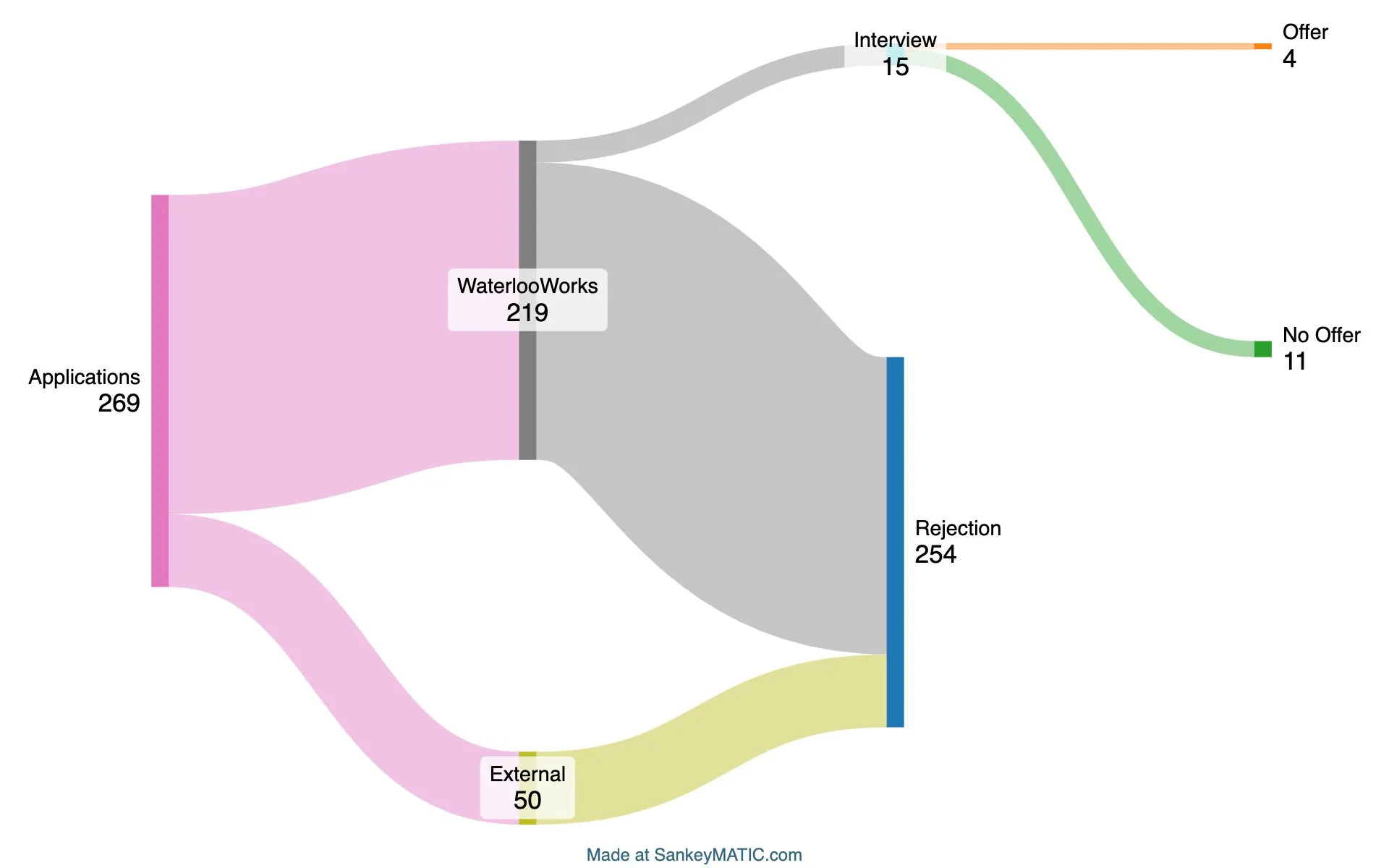
My Co-op Stats from 1B